The Wellness Market Trends and How Brands Can Differentiate
- pzconsultingbl
- Nov 4, 2022
- 4 min read
Ever heard of health is wealth? It is more than just your physical appearance, but also your spiritual wellness. Putting effort into it can be a hassle when your schedule is packed, hence, people tend to ignore the benefits of taking care of their own body. However, due to technology and R&D, products such as supplements, vitamins, and fitness apps provide convenience at your own pace. This has urged the technology industry to come up with new ideas to meet customers’ demands.
Research has shown that consumers, especially millennials, are increasingly aware of the importance of nurturing their health. According to the McKinsey research (US consumers), 50% says wellness is a priority, an increase from 42% in 2020. What are the potential drivers under this booming market?
Potential drivers in the wellness market
1. Covid-19 Pandemic
It is a lie to say that COVID has little impact on our daily lives, as a matter of fact, it still is today, even when lockdowns are removed (well, except for some). The pandemic influences consumer behaviours, fuelling the wellness industry with innovative products and ideas. The following are some examples:
Digital therapy
At-home fitness
Diet programmes
Vitamins
Supplements
Telemedicine
Mindfulness apps
Why now? The lockdowns have greatly affected the mental health of people, not being able to have human interactions and isolating ourselves indoors stifles individuals. People are critical about their health more than ever before.
2. Remote Work
Due to COVID-19, remote work/working from home is the new normal. 16% of companies worldwide have implemented 100% remote work, others have not. Hybrid working is also another flexible system for employees to do work when and wherever they want. This, of course, questions the productivity and outcome of the employee. Using the statistics from 2021, 90% of employees answered that there is no difference in productivity at home or at the office. Moreover, 22% are happier with the environment.
The ability to give employees the flexibility in their schedule is considered as a privilege from certain perspectives, thus, it gives them the opportunity to nurture their mental health. Employees stated that there is less stress, more focus and balance.
Remote working allows employees more time to focus on their fitness, by going to the gym, or working out at home. Products such as gym equipment, home fitness programme, and virtual classes strikes in demand as it enhances accessibility for users to do workouts.
3. Personalisation
Personalisation is an important role in every business today, particularly with e-commerce. The feature tailors the product to a customer’s needs, which create a sense of exclusivity. This alone could increase sales and loyalty, differentiating yourself from other brands. It is important to note that customer experience is what drives revenues up in the long-term.
4. Ability to track/regulate one’s own health state
This might be one of the most outstanding developments in the wellness industry, as users get to witness their own health and stats. Popular smart watches like the Apple watch and Fitbit track your sleep, blood oxygen levels, and heart rate. The feature saves you time from regular checkups, and can report to their healthcare professional immediately when the watch detects something concerning.
The Wellness Market Trends
Personalisation of nutrients, vitamins, and therapy
As mentioned above, personalisation is an excellent strategy to drive sales. Particularly, this strategy is not only trending in the wellness industry, but in consumer products as a whole. SMEs and large brands prioritise it as it uses customer data and information to help them understand their focus groups better. According to the McKinsey survey, 49% of millennials and 37% of Gen Z prefer personalisation.

Consumers are willing to pay more in order to receive a semi-customised or highly, fully customised product. Since personalisation is not a new concept and is a relatively familiar strategy used among nutrition brands, it is important that brands understand how to differentiate themselves with it. Doing it right will enable firms to thrive among their competitors.
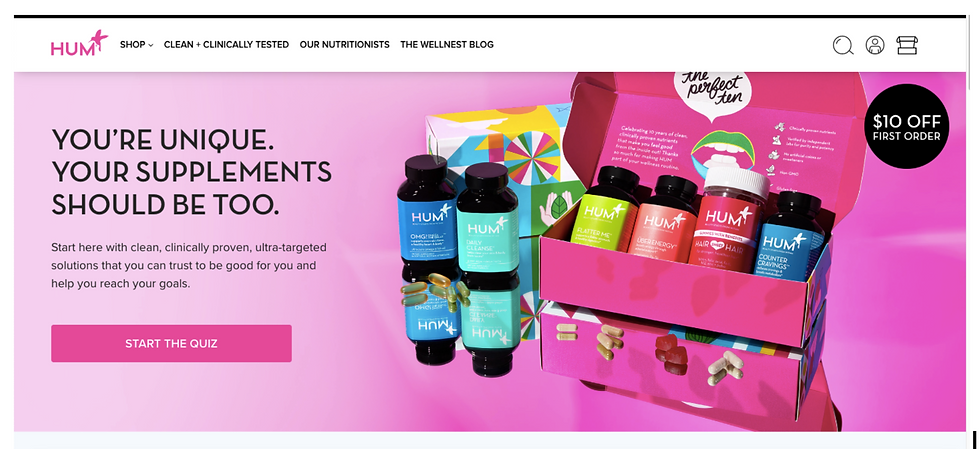
HUM Nutrition - A Los-Angeles based company that offers clinically proven nutrients personalised to your goals.
Tell us your usual food style
Let’s talk protein! Which of these do you have 3 times a week or more?
Which one of these do you drink daily?
How do you feel daily?
Betterhelp - the largest online therapy platform in the world, offering online mental health with licensed therapists via video/phone calls and chat.
Potential strategies for firms:

‘Clean’ Ingredients
Often, the concept of labelling clean ingredients is used to ensure to the consumers that the products are safe and also, being transparent with the customers is another way to increase trust among both parties. However, this has been looked at as ‘greenwashing’, as around 30% consumers now value and prioritise what is in the ingredients rather than its efficacy, according to the McKinsey survey. Greenwashing is a prevalent issue among brands, which could knock off consumer’s confidence and create a great damage to the firm’s reputation.
So how can brands be creative with their products?
With any products that relate to human’s health, transparency in every step of the process is needed. May it be from manufacturing, research and development, or even the people who created the product (their licences, certificates). It is critical for firms to develop and understand their core values first, before delivering it to the customers.
Questions firm should ask:
Values | Products |
What is the core value of the brand? What are the brand’s ethical standards? What does the brand stand for? How does the values they stand for bring values to the customers as well? | How do we portray our values onto the products? Can we portray our transparency in the product design? What is the impact when customers purchase our product? |
Possible strategies:
Brands should use their biggest social media/internet platforms to communicate effectively with the consumers.
Displaying core values, beliefs, ethos, etc. on the company’s website
Disclosing information about ingredients, and explain if there is any common misunderstanding about ‘clean ingredients’ (giving customers knowledge about the industry is a plus)
Do testing policies or get licences to prove your products are safe for consumption and the environment (to gain competitive advantage in the future)
Show how you source materials (Ex: country of manufacture/manufacturers you are working with)

Comments